

Google Search is moving beyond the traditional model of entering a keyword, scanning a list of blue links, and clicking through to a website. AI is increasingly becoming the layer through which people ask questions, explore topics, compare options, and make decisions. At Google I/O 2026, Google described this direction through a broader AI Search experience that brings AI Overviews, AI Mode, intelligent inputs, and emerging agent capabilities closer together. AI Mode has already surpassed one billion monthly users, while Google says queries in the experience have more than doubled each quarter since launch.
For brands, this does not mean traditional SEO suddenly stops working. It means the definition of search visibility is expanding. Your website may still need to rank in conventional organic results, but it increasingly needs to provide information that AI systems can understand, evaluate, summarize, and potentially cite in generated answers. The brands best prepared for this transition are not necessarily those chasing every new AI tactic. They are the ones that have already invested in authoritative content, strong technical foundations, clear information architecture, topical depth, and genuine expertise.
The important shift is therefore not simply from SEO to AI SEO. It is from optimizing for a page position to building a brand that can remain visible wherever Google’s evolving search experience surfaces information.
What Google Actually Announced
Google’s 2026 Search announcements point toward a search experience designed to understand more complex requests and do more than simply return a collection of webpages. Three developments are particularly important for brands: the Intelligent Search Box, Information Agents, and Agentic Search.
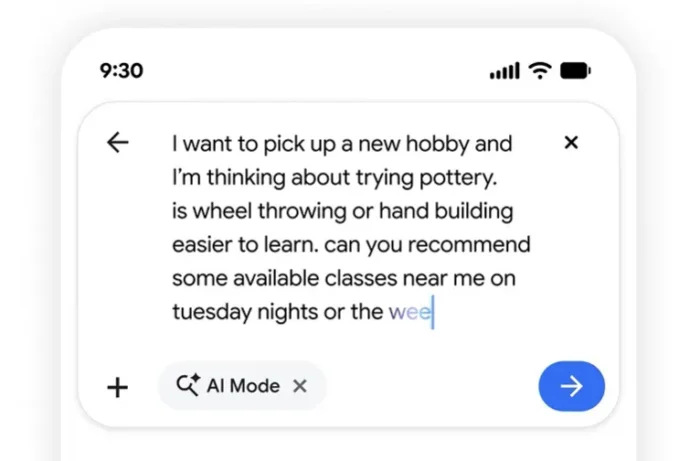
The Intelligent Search Box represents a significant change to the traditional search interface. Instead of treating the search box primarily as a place to enter a short keyword phrase, Google’s new experience is designed to handle richer and more complicated inputs, including text, images, files, and Chrome tabs. AI-powered intent suggestions are also intended to help users explore more sophisticated searches. AI Overviews and AI Mode are being brought together within this broader experience.
This matters because the questions people ask can become much more detailed. A user might not simply search for “CRM software.” They could ask Google to compare CRM platforms for a particular business size, budget, workflow, industry, and set of requirements. Search consequently has to understand the relationships between multiple pieces of information rather than simply match a few words on a webpage.
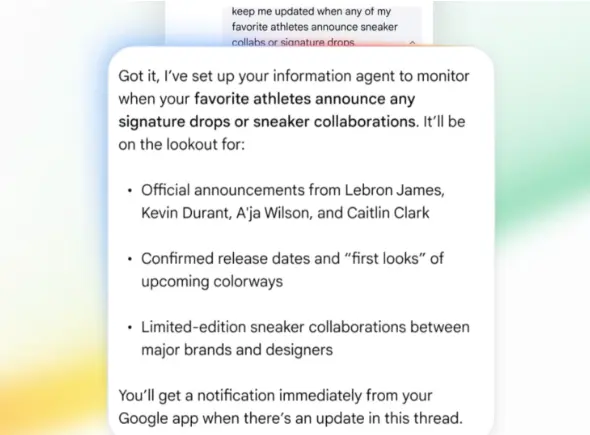
The second development is Information Agents. These are designed to monitor information continuously on behalf of users rather than requiring them to perform a new search every time something changes. For example, a user could ask an agent to watch for developments involving a particular topic, product, person, or category and receive an update when something relevant happens.
That creates a new form of search visibility. A brand does not necessarily have to wait for someone to search its target keyword. If its information is relevant to an ongoing topic that a user has asked an agent to monitor, the brand’s content could become part of the information being evaluated and summarized.
The third development is Agentic Search. Rather than stopping after generating an answer, agentic capabilities can help users create useful outputs such as tools, dashboards, and trackers within the search experience. This moves Search closer to an environment where users can ask for an outcome and have AI help construct something that accomplishes the task.
For marketers, the broader message is clear: Google is evolving from a system that primarily finds webpages into a system that can understand information, synthesize it, monitor it, and help users act on it. That makes the quality and structure of the information a brand publishes increasingly important.
What This Means for Organic Search
The biggest change for organic search is that ranking is no longer the only form of visibility that matters.
Traditional SEO has historically centered on winning positions in Google’s organic results. A page ranking first could potentially capture a substantial share of clicks for a query. AI-generated search experiences complicate that model because users can receive a synthesized answer before they ever reach the traditional organic listings.
This is the broader zero-click search problem. AI Overviews and AI Mode can satisfy part or all of a user’s information need directly within Google. Recent data cited in the source material indicates that position-one click-through rates have already fallen substantially in some markets as AI-generated results have expanded.
That does not make organic rankings irrelevant. Instead, it creates a more complicated visibility equation.
A brand now has to think about at least two connected outcomes:
- Traditional organic visibility: Does the page rank for relevant searches?
- AI visibility: Can the brand’s information be surfaced, referenced, or cited within AI-generated responses?
A third dimension is beginning to emerge as agentic experiences develop: persistent visibility. Information Agents may monitor topics over time, meaning the opportunity is not limited to appearing when someone performs a single search. Brands that consistently publish useful, current, authoritative information may have more opportunities to become part of the information ecosystem that AI systems evaluate.
This changes how businesses should evaluate SEO performance. Traffic and rankings remain important, particularly for commercial, transactional, and navigational searches. But they should increasingly be evaluated alongside broader indicators such as brand mentions, AI citations, visibility within AI-generated answers, branded search demand, and the quality of third-party signals surrounding the business.
The shift also increases the importance of content quality. AI systems have an enormous amount of information available to evaluate. Publishing another generic article that repeats what hundreds of other websites already say gives a brand little reason to be selected. Original research, first-hand experience, unique data, expert commentary, and genuinely useful insights give content a stronger reason to be referenced.
In other words, organic search is not disappearing. The environment in which organic content is discovered and consumed is changing.
Why Existing SEO Foundations Still Win
One of the biggest misconceptions surrounding AI Search is that businesses need to abandon their existing SEO strategies and start over. They do not.
The fundamentals that make a website useful to search engines also make its information easier for AI systems to understand. Technical accessibility, logical site architecture, relevant content, topical authority, strong internal linking, trustworthy information, and evidence of real expertise remain valuable foundations.
Consider technical accessibility first. If search engines cannot reliably crawl, render, understand, or index your content, an AI-driven search system has less information to work with. Maintaining a technically sound website therefore remains essential.
Then there is intent-focused content. Instead of creating pages simply because a keyword has search volume, brands should understand what users are actually trying to accomplish. AI search encourages more conversational and complex queries, making it increasingly important to answer the underlying question rather than mechanically repeat a target phrase.
Topical authority also becomes more valuable. A single page can answer one question, but a strong content ecosystem can demonstrate that a brand understands an entire subject. Comprehensive coverage across related questions gives search systems more context about the brand’s expertise and the relationships between its content.
The same applies to experience and credibility. Content that demonstrates first-hand knowledge, original research, expert credentials, case studies, proprietary data, or practical experience gives both users and search systems stronger evidence that the information is worth trusting. Generic content produced solely to capture keywords has a much harder time differentiating itself in an environment where AI can synthesize basic information instantly.
Structure matters, too. Clear headings, concise explanations, descriptive page elements, logical organization, appropriate structured data, and direct answers make content easier to interpret. These practices are not magic shortcuts for getting cited by AI, but they help make the information understandable to both people and machines.
The strategic takeaway is therefore reassuring: AI Search changes the surface, but it does not erase the foundations of good SEO.
What changes is the goal. Instead of asking only, “How do I get this page to rank?” brands should also ask:
- Can Google clearly understand what this page is about?
- Does it directly answer the questions my audience is asking?
- Does my brand demonstrate genuine expertise?
- Is the information accurate and current?
- Does the content provide something competitors cannot easily replicate?
- Could an AI system confidently use this information when constructing an answer?
- Does my brand have authority beyond its own website?
Brands that can answer these questions well will be better positioned for both traditional organic search and AI-driven discovery. The future of Google Search may look very different from the classic ten-blue-links model, but the underlying principle remains familiar: useful, trustworthy, accessible information gives your brand something worth finding, understanding, and recommending.
The Click-Through Collapse Is Already Happening
The shift toward AI-powered search is changing more than how Google delivers answers. It is also changing what happens after a user sees the search results. When AI Overviews or AI Mode can summarize information directly on the results page, users may have less reason to click through to individual websites for simple informational queries.
The source material highlights just how significant this change can be: the average click-through rate for a traditional position-one result has fallen from roughly 27% to 11% as AI-generated search experiences have expanded. While the exact impact varies by query, industry, search feature, and intent, the strategic lesson is important: ranking first does not automatically guarantee the traffic it once did.
That does not mean Google is sending no traffic to websites. In fact, Google says its AI-powered Search features are sending billions of clicks to websites every week, and it continues to add prominent links and website previews within AI experiences.
The problem is that the relationship between visibility, clicks, and conversions is becoming more complicated.
A user searching for a basic definition may be satisfied by an AI-generated response. Someone comparing several products may receive a synthesized comparison before visiting a brand’s website. A user researching a complex topic may still click through to original research, product pages, reviews, or expert sources because the AI response creates a reason to explore further.
This means brands need to stop treating every search impression as an automatic path to a website visit.
The more important question becomes:
What makes someone want to click your brand after AI has already given them an answer?
The answer is usually depth, originality, trust, and a clear next step.
If your content simply repeats information that an AI system can summarize in a few sentences, the value of the click becomes weaker. But if your page contains original research, detailed comparisons, first-hand experience, proprietary data, expert analysis, tools, examples, or information that requires deeper investigation, it gives users a stronger reason to continue.
Google’s own recent Search updates reinforce this direction. AI Overviews and AI Mode are being designed with more links, website previews, Preferred Sources, and ways to discover original content. Google has also introduced a “Highly Cited” badge to help users identify influential coverage and original reporting.
So the future is not necessarily “AI answers mean no more website traffic.” It is closer to “generic answers may earn fewer clicks, while valuable sources can become more important.”
That distinction should influence how brands approach SEO today.
What to Do Now
The best response to AI Search is not to abandon SEO and chase every new AI trend. Instead, strengthen the parts of your search strategy that help your brand become understood, trusted, discoverable, and useful across both traditional and AI-powered search.
1. Keep Your Existing SEO Foundations Strong
Continue investing in technical SEO, crawlability, indexability, site architecture, internal linking, page experience, and structured content.
AI-powered Search still depends on information from the web. If your important content is difficult for search systems to discover or understand, AI does not eliminate that problem.
Your technical SEO should therefore remain the foundation rather than something you replace with an “AI SEO” shortcut.
2. Build Content Around Real User Intent
AI Search is particularly effective at handling longer and more conversational questions. Google’s AI Mode is designed to understand complex requests and can break a question into multiple searches to investigate different aspects of the topic.
That means your content strategy should go beyond individual keywords.
Instead of creating one page for every minor keyword variation, identify the underlying problem your audience is trying to solve and build useful resources around it.
For example, rather than targeting only “email deliverability,” a comprehensive resource might address:
- What email deliverability means
- Why emails go to spam
- How sender reputation works
- Authentication requirements
- List hygiene
- Engagement signals
- Technical configuration
- Monitoring and troubleshooting
This gives your brand more opportunities to provide useful information across the different subtopics an AI system may investigate.
3. Make Your Content Worth Citing
AI systems can summarize generic information very easily. Your competitive advantage comes from information that is difficult to reproduce.
Prioritize:
- Original research
- Proprietary statistics
- First-hand experience
- Expert interviews
- Case studies
- Unique frameworks
- Detailed comparisons
- Product or service testing
- Original examples
- Industry-specific analysis
Google is actively emphasizing original content and firsthand perspectives within its AI search experiences.
If your content gives an AI system something genuinely useful and distinctive to reference, it has a stronger reason to appear in an AI-generated response.
4. Strengthen Brand Authority Beyond Your Website
AI visibility is not purely a website optimization problem.
Your brand’s reputation can be reinforced through reputable publications, industry organizations, reviews, expert contributions, interviews, partnerships, and other credible third-party sources.
Think about the difference between a company that says “we are experts” on its own website and a company whose expertise is consistently demonstrated across independent sources.
The second creates a stronger overall trust signal.
5. Optimize for the Answer and the Next Step
Your content should be capable of providing a concise answer while also giving users a reason to continue.
A useful page structure can include:
- A direct answer near the beginning
- Supporting explanation
- Evidence or examples
- Original insights
- Frequently asked questions
- Relevant visuals or data
- A clear next action
This works for both humans and AI systems. The AI can understand the core answer, while users who need more information have a logical path to continue exploring.
6. Start Monitoring AI Search Visibility
Traditional rank tracking should not disappear, but it should no longer be the only visibility measurement.
Test important commercial and informational queries in Google’s AI experiences and document:
- Whether your brand appears
- Whether your website is cited
- Which pages are referenced
- Which competitors appear
- What sources are repeatedly mentioned
- What information AI associates with your brand
- Whether the generated information is accurate
- Whether your brand appears for different versions of the same intent
This can reveal gaps that traditional ranking reports cannot.
7. Prepare for Search Agents
Information Agents are designed to work in the background, continuously monitoring information and notifying users when something relevant changes. Google announced that these agents would begin rolling out in summer 2026, initially for Google AI Pro and Ultra subscribers.
That makes freshness increasingly important for some industries.
If your business publishes pricing, product availability, events, regulatory updates, inventory, market information, news, or other frequently changing information, make sure those details are accurate and easy to discover.
The opportunity is not simply to rank once. It is to become a consistently useful source of information.
8. Do Not Overreact to Every New AI Feature
AI Search will continue to evolve. Features, interfaces, ranking systems, and agent capabilities will change.
Your long-term strategy should therefore focus on principles that remain valuable regardless of the interface:
Be technically accessible. Be genuinely useful. Demonstrate expertise. Publish original information. Keep important information current. Build authority. Understand user intent.
Those principles can survive changes in how Google presents search results.
FAQs
Does this change my existing SEO strategy?
It changes the emphasis, not the foundation.
You should continue investing in technical SEO, content quality, internal linking, crawlability, structured information, topical authority, and relevant backlinks. However, you should expand your strategy to account for AI-generated answers and the possibility that users may interact with Search without immediately clicking an organic result.
The biggest adjustment is to measure visibility and influence, not just rankings and sessions.
A page can be valuable even when it does not generate the same number of clicks it once did if its information is being surfaced in AI responses, strengthening brand awareness, influencing consideration, or driving qualified users later in the journey.
When do Information Agents launch?
Google announced in May 2026 that Information Agents would launch during summer 2026, starting with Google AI Pro and Ultra subscribers. They are designed to work in the background and monitor information across the web, notifying users when relevant changes occur.
For brands, the important point is not simply the launch date. Information Agents represent a broader change in search behavior: users can increasingly ask systems to keep track of information for them rather than repeatedly performing searches themselves.
That makes accurate, current, discoverable information especially important for businesses operating in fast-changing categories.
Does ranking still matter if AI answers the query directly?
Yes. Ranking still matters, but it is no longer the complete picture.
Organic rankings can continue to generate visibility, traffic, brand recognition, and conversions. Google’s AI experiences also continue to include links to websites, and Google says AI-powered Search features are sending billions of clicks to websites each week.
However, a top organic position may no longer produce the same click volume for every query.
Brands should therefore think beyond “What position do we rank at?” and ask:
- Are we visible in AI-generated answers?
- Are our pages being cited?
- Are competitors being mentioned instead?
- Does our content provide something worth exploring beyond the summary?
- Are we building branded demand that exists beyond a single search result?
The goal is becoming broader than ranking. It is owning visibility throughout the search journey.
What is Agentic Search and should brands care about it now?
Agentic Search refers to search experiences that can do more than retrieve and summarize information. They can use AI agents to help complete tasks, create useful outputs, and take actions based on a user’s request.
Google is expanding agentic capabilities across Search, including agentic booking and other task-oriented experiences. It has also announced capabilities that can create custom experiences such as interactive visuals, tools, dashboards, and trackers.
Brands should care because this could change how customers move from searching to acting.
For example, instead of searching for local service providers and manually comparing them, a user could eventually ask an agent to find suitable businesses based on specific requirements and help complete the next step.
Businesses should therefore make important information easy for systems to understand: services, products, pricing where appropriate, availability, locations, policies, qualifications, reviews, and other decision-making information should be accurate and consistent across relevant sources.
You do not need to redesign your entire SEO strategy around agentic search today. But you should make sure your business information is structured, current, trustworthy, and accessible so your brand is prepared as these experiences expand.
Conclusion
Google Search is becoming increasingly AI-driven, but this does not mean SEO is dead. It means search visibility is becoming broader than a blue-link ranking.
AI Overviews and AI Mode can answer more questions directly, while Information Agents can monitor topics in the background and emerging agentic capabilities can help users move from information toward action. Google says AI-powered Search is already driving increased search activity and billions of weekly clicks to websites, showing that the web remains an important part of the experience even as the interface changes.
For brands, the safest strategy is not to chase every new AI feature. Build the fundamentals that make your business valuable in any search environment: strong technical SEO, authoritative content, genuine expertise, original information, consistent brand signals, and a deep understanding of customer intent.
The brands that win in AI Search will not simply be the ones that rank. They will be the ones that become trusted sources worth understanding, citing, visiting, and ultimately choosing.
Read More: Large Language Model (LLM) Editing Quietly Corrupts Documents: What the Research Says


